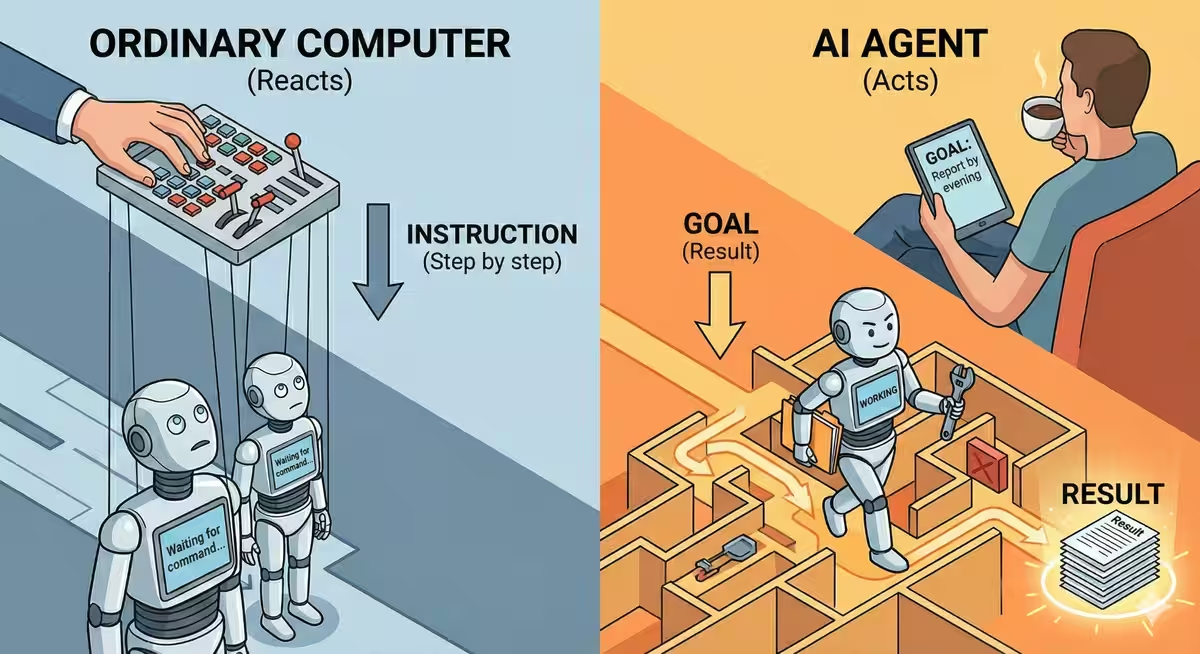
A normal computer always waits. Commands. Clicks. Your instruction.
Even “smart” programs don’t do anything on their own — they react. You ask — they answer. You click — they execute. You stop — they stop too.
Now imagine something else.
You say: “I need a report by this evening.”
And the system understands that as work.
It doesn’t wait for the next command, doesn’t ask where to start, and doesn’t stop when a file won’t open or data is missing. It looks for another path. Tries again. Finds a solution.
- You stepped away for coffee — it keeps working.
- You’re in a meeting — it keeps working.
- You don’t even remember it — and it’s almost finished.
And it comes back only when there’s a result.
At that moment, the computer stops being a tool.
You’re no longer in control — you delegate.
That’s exactly what an AI Agent is.
Why everyone confuses AI Agents
The word agent today gets slapped onto anything that has AI.
Onto chats. Onto auto-reply buttons. Onto programs that just do something on a schedule.
A company adds GPT to its product — and already writes:
“Meet our agent.”
But the problem isn’t the name. The problem is what’s behind it.
Most of those systems don’t actually do anything on their own. They wait. Until a person says something. Until they click a button. Until they give a command.
You gave an instruction — they executed it.
You stopped — they did too.
That’s not an agent. It’s just a more convenient program.
A real AI Agent isn’t the one that answers nicely.
It’s the one that keeps working, even when you stop watching it.
If a system can’t take the next step without you — it isn’t acting. It’s reacting.
And the difference between those two things is huge.
So what is an AI Agent really
| Normal Program | AI Agent | |
|---|---|---|
| Waits for a command | ✅ | ❌ |
| Works on its own | ❌ | ✅ |
| Moves toward a result | ❌ | ✅ |
An AI Agent is a system you give a result, not an instruction.
You don’t explain what to do step by step. You describe the task — and it decides where to start, which tool to use, and when to stop.
If something fails along the way — a file is unavailable, an API doesn’t respond, data is incomplete — the agent doesn’t “crash” and doesn’t wait for you. It tries another path, looks for an alternative, changes its approach.
If there are no options left, it comes back and says so honestly.
In other words, an agent is a system that moves work toward a goal on its own — not just one that reacts to your actions.
That’s why with an agent you don’t control every step.
You delegate — and wait for a result.
In short
A normal program reacts to your commands.
An AI Agent receives a task and moves toward a result on its own.
You don’t control every step. You delegate — and wait for completion.
FAQ
Q: What is an AI Agent?
A: An AI Agent is a system you give a result, not an instruction. It decides how to move toward the goal.
Q: How does an AI Agent work?
A: It receives a task and tries to complete it on its own, without waiting for step-by-step guidance from a person.
Q: What makes an AI Agent different from a normal program?
A: A normal program reacts to commands. An AI Agent can keep working on a task even when you’re not giving new instructions.
What’s next
If an AI Agent is a system you delegate a result to, then a natural question follows.
How is it different from ChatGPT? And from ordinary automation that can also do something without you?
From the outside, everything can look similar. The system works on its own. Sometimes it even uses AI.
But how it works is fundamentally different.
That’s what the next article is about.