When people first see an agent working by itself, they almost always have one reaction:
"Does it really think on its own?"
From the outside, it really does look impressive. You do not click anything, do not suggest the next step, and do not guide the process by hand, yet the system still does something.
It tries one option, it fails. It looks for another. It changes the approach. And eventually it comes back with a result.
At that moment, it is easy to believe some kind of magic is happening inside. But there is no magic here. There is fairly simple logic.
An agent does not "think" like a human, it works in a loop
When we say an agent "thinks", we are actually describing a feeling, not what is really happening.
From the outside, it looks like thinking: the system seems to pause, "consider" something, and then make a meaningful step. But inside, everything is simpler.
It simply repeats one process:
And again.
From the outside, this looks like "smart behavior". But in reality, this is a loop, not thinking.
The same principle as when a person tries to open a locked door: first pull, then push, then look for a key. Not because they designed a perfect plan, but because they try options until something works.
Because of this loop, the agent does not break on the first error. It does not expect everything to go according to plan. For it, an error is just another state to move forward from.
An agent can sometimes make a plan, but even then it does not execute it all at once.
It still moves in a loop: assess the situation -> choose an action -> check the result -> and adjust the plan when needed.
Loop structure: how an agent moves forward
Despite all the "magic", an agent loop is very simple. It consists of a few steps that repeat continuously.
- Understanding the situation The agent looks at what is there now: what data is available, what has already been done, what went wrong. This is not deep analysis, just state capture.
"Okay, I am here. What do I have?"
-
Choosing the next step Based on this, it chooses an action that makes sense exactly at this moment. Not the best in theory. Not perfect. Just the next reasonable attempt.
-
Action It does what it chose: calls a tool, works with data, changes the situation. There is no guarantee that it will work. This is an attempt, not a plan.
-
Checking the result After the action, the agent looks at what changed. Closer to the goal means good, keep moving. New information means adjust course. Path is blocked means look for another one.
And again, around the loop. Until there is a result. Or until the agent runs into a boundary it can no longer cross.
Live example: how an agent runs the loop on a real task
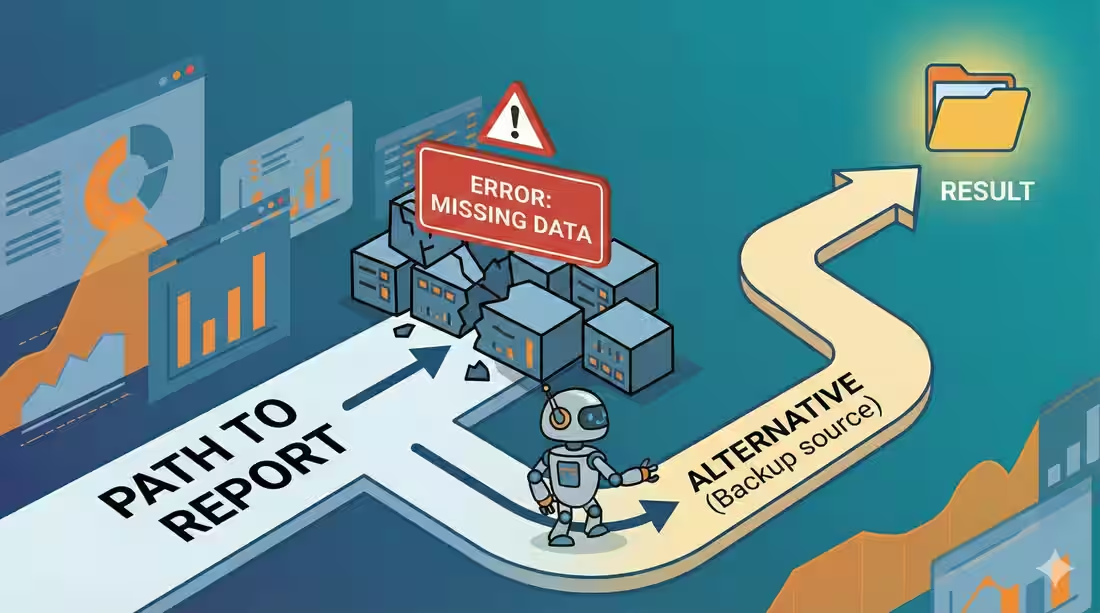
Imagine a simple task. You tell the agent:
"Prepare a spend report for last week by this evening."
No instructions. No steps. Only the result. Here is what happens next, step by step.
Loop 1: Understanding the situation
The agent starts by reviewing what exists. Where can spend data be: in a database, in files, in an analytics service?
It finds the main source, the accounting system, and sees a problem: part of Tuesday's data is missing.
This is not an error. This is simply the current state.
Loop 2: Choosing the next step
The agent does not stop and does not write: "What should I do?"
It picks an obvious attempt: check a backup source. Maybe the data exists in logs. Maybe in another service. Maybe in cache.
This is not a perfect solution. This is simply the next reasonable step.
Loop 3: Action
The agent checks system logs to extract missing data.
Result: it finds part of it. Part of it does not.
It merges what it has and sees: for a full report, several Tuesday values are still missing.
Loop 4: Check and new decision
The agent looks at the full picture. The report is almost ready, but there are gaps.
Now it has several options:
- try one more source
- estimate data approximately
- record that part of the information is unavailable
It chooses the third option: finish the report with a note about missing data. This allows progress without lying.
Loop 5: Final action
The agent prepares the report: weekly spend table, trend chart, conclusion.
In the note it states: "Data for October 8 (Tuesday) is partially unavailable due to an outage in the accounting system. The report is based on the available 87% of records."
It saves the file. Done.
Back to you
The agent writes: "Report is ready. Last week's data has been collected, part of Tuesday's records was unavailable and documented in the note. File attached."
What matters here
At no point did the agent:
- wait for the next command
- "crash" because of an error
- stop because something was not perfect
It simply went through the loop again and again until it reached the best possible result under these conditions.
That is why from the outside it feels like the agent "thinks". But in reality, it does not think, it does not stop.
In short
An AI agent is useful not because it "thinks". And not because it is always right. It is useful because it does not stop when something goes off plan. An agent does not know the ideal path in advance. It simply moves toward the goal, constantly checking what worked and what did not. For it, an error is not failure and not a reason to wait for a human, but another state from which it can make the next step. It is exactly this persistence that creates the feeling of "smart behavior". Not magic. Not consciousness. Just a loop that does not break on the first failure.
FAQ
Q: Does an agent really "think" before doing something?
A: No. What looks like thinking is loop repetition: assess state -> choose action -> check result.
Q: What happens if an action does not work?
A: The agent checks the result and tries another option in the next loop.
Q: When does the agent stop working?
A: When a result is reached or when further actions no longer make sense.
What is next
Now that you understand how an agent moves in a loop and why it does not stop at the first error, it is time for the next step.
Let us move to practice: Build your first AI agent