After conversations about AI agents, a logical question often appears:
So how is an agent different from ChatGPT? And from regular automation?
Because from the outside, everything looks the same.
You type something, and the system responds.
You set a task, and the system does something.
Sometimes even without your participation.
ChatGPT can write a report.
An automated process can generate it.
An AI agent can too.
The result may look the same. But how that result appears is completely different.
And this difference determines:
- whether the system stops at the first error
- whether it keeps working
- whether it can finish the task without you at all
To understand what is chat, what is automation, and what is an agent, you need to look not at the name, but at behavior.
| ChatGPT | Automation | AI agent | |
|---|---|---|---|
| Has a goal | ❌ | ❌ | ✅ |
| Executes actions | ❌ | ✅ | ✅ |
| Chooses the next step | ❌ | ❌ | ✅ |
| Adapts to errors | ❌ | ❌ | ✅ |
| Works without a human | ❌ | ✅ | ✅ |
| Achieves a result | ❌ | ⚠️ If everything goes according to plan | ✅ |
ChatGPT: responds, but does not act
Let us start with the simplest one.
ChatGPT is a system that responds to prompts. You ask a question, and it gives an answer. You ask it to write something, and it writes.
But it does not do the work on its own.
ChatGPT does not check whether a file opened, does not look for another source if data is missing, and does not decide what to do after an error.
It has no goal, only a prompt.
It has no process, only a response.
That is why ChatGPT exists only while you interact with it. Once you stop typing, it stops.
That is why ChatGPT is a conversation partner, not an executor.
Automation: follows a plan, but does not decide
Now imagine another option.
A system that does not answer prompts, but executes an action.
For example:
- generates a report every day at 12:00
- sends an email after signup
- updates data once an hour
You do not type anything. It works on its own.
But only within the boundaries of what was planned.
Automation acts by a scenario: first do this, then this, then this.
If everything goes according to plan, it works great.
But if something goes wrong, a file does not open, data is missing, or an API does not respond, the process stops.
Because automation does not decide what to do next. It executes what was already decided for it.
So automation is a process, not an executor.
AI agent: acts, even when the plan does not work
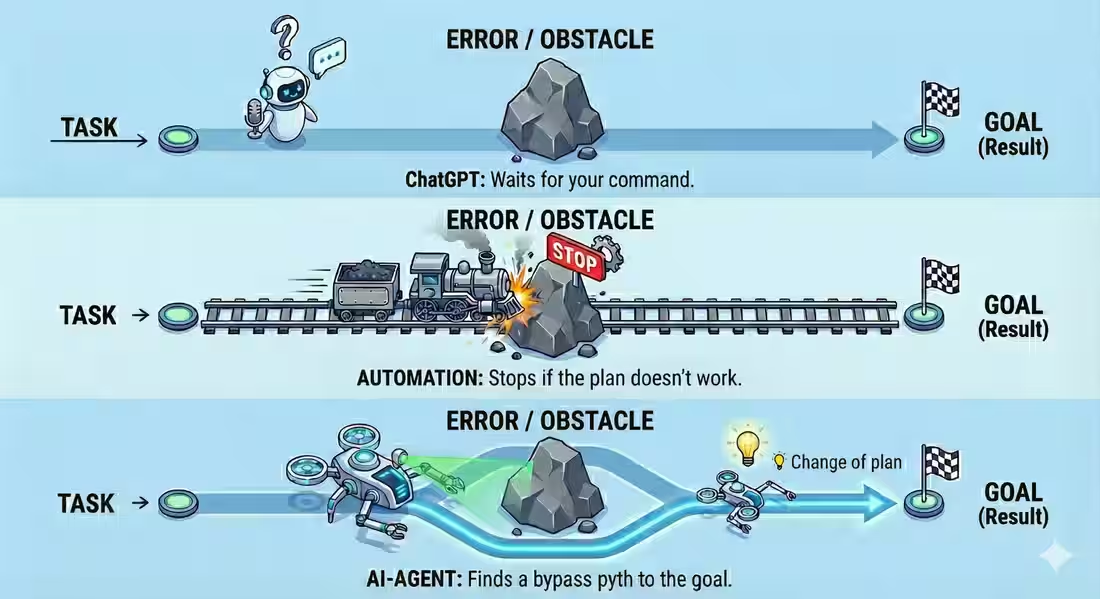
An AI agent combines two things.
Like ChatGPT, it can analyze the situation and choose the next step.
Like automation, it can execute an action.
But unlike both, it does not stop when something goes off plan.
ChatGPT will say: "I cannot access the file."
Automation will output: "Error: process failed at step 3".
An agent?
An agent looks for another source.
Tries a tool.
Changes the approach.
It does not wait for you to tell it what to do next.
Because its job is not to respond to a prompt and not to execute a scenario.
Its job is to achieve the result.
That is why an agent can finish the work even when the original plan does not work.
In short
ChatGPT responds to a prompt.
Automation executes a scenario.
AI agent achieves a goal.
FAQ
Q: How is an AI agent different from ChatGPT?
A: ChatGPT responds to prompts, but does not perform work independently. An AI agent can keep working on a task even after an error, without waiting for a new instruction.
Q: How is an AI agent different from automation (workflow)?
A: Automation executes predefined steps. If something goes wrong, the process stops. An AI agent can change its approach and try another path to the result.
Q: What happens if something does not work?
A: ChatGPT reports the problem. Automation stops. An AI agent tries another option or adjusts the plan to reach the result.
What is next?
If an agent makes decisions on its own, chooses tools on its own, and defines the next step on its own, how exactly does it do this?
What actually happens inside when you say:
"get this done by tonight", and the system really starts acting?
That is exactly what the next article is about.