When we say an AI agent can act on its own, a logical question appears:
What inside allows it to do this?
Why does it not just answer prompts like ChatGPT, and stop at the first error like automation?
To work independently, an agent needs more than just a "model" that generates text.
It needs structure.
Specifically:
- Goal, which it moves toward
- Tools, to change something in the world
- Memory, so it does not start from zero every time
- Loop, which lets it try again after failure
Without this, an agent does not act.
It only responds.
This structure is exactly what turns a model into a system that can receive a task and move toward a result independently.
| Component | What it does |
|---|---|
| 🎯 Goal | Defines the outcome that must be achieved |
| 🛠 Tools | Allow actions in the world |
| 🧠 Memory | Stores previous steps and outcomes |
| 🔁 Loop | Allows trying again after an error |
Goal: what the agent is trying to achieve
Everything starts with a goal.
An agent does not work "just because." It always tries to reach a specific outcome.
This can be:
- Produce a report
- Find information
- Reply to a customer
- Optimize costs
The key point is that the agent gets an outcome, not a list of steps.
You do not explain what to do first, then next, and then after that.
You say: "I need a report by this evening."
And then it itself decides:
- Where to start
- Which tool to use
- What to do if something does not work
A goal is what allows an agent to keep moving forward even when the initial plan fails.
Without a goal, there is no movement. There is only instruction execution.
Tools: how the agent interacts with the world
A model by itself changes nothing.
It can analyze text, draw conclusions, suggest decisions, but it cannot execute an action.
For an agent to do something in the real world, it needs tools.
For example:
- Call an API
- Read a file
- Write data to a database
- Send an email
- Run a process
Tools are how a decision becomes an action.
The agent does not just "think" about what must be done. It has the ability to do it.
Through tools, it can:
- Get new data
- Change system state
- Verify the result of its actions
Without tools, an agent can only respond.
With tools, it can act.
Memory: how the agent avoids starting from zero every time
Every action by an agent changes the situation.
It gets new data. Makes conclusions. Tries different approaches.
To move forward, it needs to remember:
- What has already been done
- What worked
- What did not
- And where it stopped
Without memory, every step would look like the first one.
The agent would start from zero each time: checking the same sources, trying the same tools, repeating the same mistakes.
Memory allows avoiding this.
It stores:
- Previous actions
- Received results
- Intermediate decisions
And this is exactly why the agent can change approach when something does not work, instead of trying the same thing again.
Without memory, there is no learning. There is only repetition.
Loop: how the agent moves toward a result
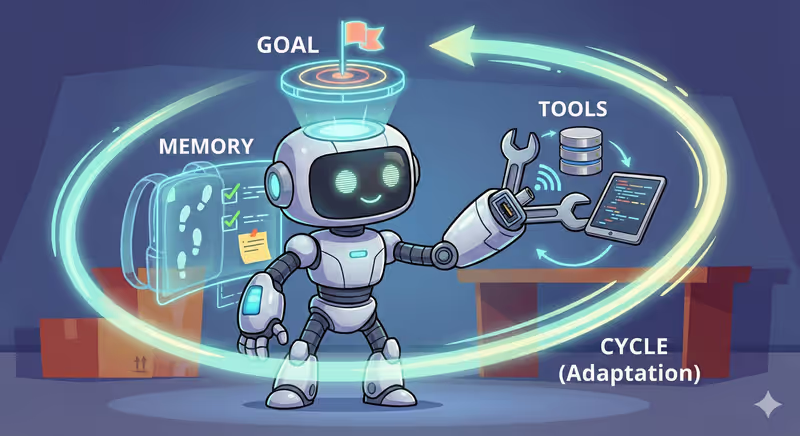
The goal gives direction. Tools allow action. Memory helps avoid repeating mistakes.
But it is the loop that makes all of this work together.
An agent does not try to solve the task in one step. It moves gradually.
First it looks at the situation. Chooses an action. Executes it. Checks the result.
And based on this, decides what to do next.
If something does not work, it tries a different approach.
If new data appears, it changes the plan.
And goes through this loop again.
That is exactly why an agent can keep working even when something goes wrong.
It does not stop after the first error.
It adapts.
Real-life analogy
Imagine a courier who gets the task: "Deliver the package by 6:00 PM."
No one explains:
- which road to take
- which transport to choose
- what to do if the road is blocked
They only give a goal.
To reach it, the courier uses:
- Tools: phone, map, transport
- Memory: which roads were already checked, where traffic jams were
- Loop: checked route -> departed -> hit a problem -> changed path
If one road is closed, the courier does not stop. They choose another. If there is traffic, they change route.
They constantly:
- assess the situation
- make decisions
- act
- check results
And repeat this until the goal is reached.
This is exactly how an AI agent works.
You give it the outcome that must be achieved, and then it itself:
- decides what to do
- uses tools
- checks whether it helped
- and tries again if not
In short
An AI agent is not one model.
It is a system that has:
- Goal: where to move
- Tools: how to act
- Memory: what has already been done
- Loop: how to try again
Together, they allow an agent to receive a task and move toward a result independently.
FAQ
Q: Is an AI agent just one model?
A: No. An AI agent is a system that combines a model with a goal, memory, tools, and an action loop.
Q: Why does an agent need memory?
A: So it does not start from zero every time, and can use previous actions and outcomes in the next steps.
Q: What is a loop in agent work?
A: It is a repeating process: assess the situation -> choose an action -> check the result -> decide what to do next.
What is next
Now you know what an AI agent is made of.
Goal, tools, memory, and loop: together they turn a model into a system that can act independently.
But this raises the next question.
When an agent "uses a tool," what actually happens?
How can a model that works with text call an API?
How does it "know" it should read a file or write data into a database?
And most importantly, how does it choose which tool to use right now?
This is not just a technical detail.
This is the foundation of how an agent interacts with the world.